Landed House vs High-Rise in Malaysia: Which Is Better? (2026 Buyer's Guide)

Quick Answer
Choose a landed property if you have a large or growing family, value space and privacy, and want stronger long-term capital appreciation—and you can afford the higher upfront price and upkeep. Choose a high-rise property if you're a first-time buyer who wants a more affordable entry price, a central location, built-in facilities, and gated-and-guarded security, and you're comfortable with maintenance and sinking fund fees. In short: landed wins on space, privacy, and resale value; high-rise wins on price, facilities, security, and rental yield.
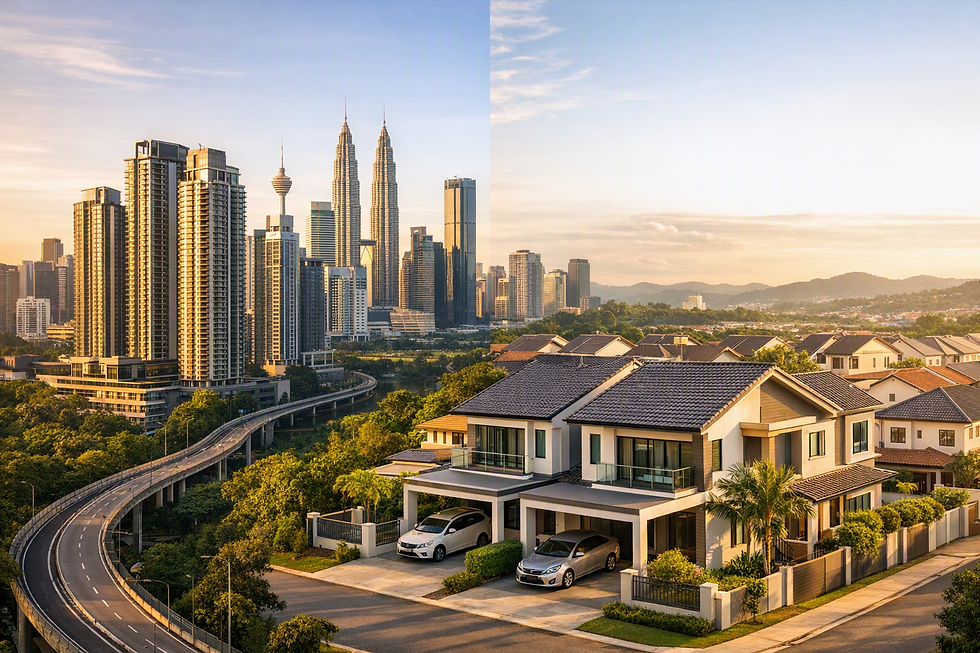
Landed vs High-Rise at a Glance
Factor | High-Rise (Condo/Apartment) | Landed (House/Townhouse) |
Entry price | Generally lower; good for first-time buyers | Higher, especially near city centres |
Living space | Typically smaller, higher density | Larger, family-friendly |
Facilities | Pool, gym, security, gardens included | Few or none (unless gated community) |
Security | Built-in gated-and-guarded, CCTV, access cards | Self-arranged unless gated-and-guarded |
Rental yield | Higher; strong tenant demand | Generally lower |
Resale / appreciation | Moderate | Typically appreciates better long-term |
Ongoing fees | Maintenance + sinking fund; possible SST | Mainly quit rent & assessment; higher upkeep costs |
Privacy & noise | Shared floors; potential noise | More peace, quiet, and privacy |
Best for | First-time buyers, investors, city dwellers | Families, long-term owners, multi-gen living |
How Do You Decide Between Landed and High-Rise?
Finding the right type of property to purchase can be quite a confusing task – but we’re here to help you pick out the best one for your needs.
First off, you’d need to decide if you want to live high up in the sky, or as close to the ground as possible.
Key Legal Terms to Check First
Depending on which one you choose, you’d have to also consider a few other important matters, such as:
Strata Title or Individual Title – These are legal documents which state that you are the one who has lawful ownership of the property.
Freehold or Leasehold – The former belongs completely to the individual with no control from the government; however, under the Land Acquisition Act 1960, your property can still be taken back by the state, provided that the land is used for public purposes like a train line. On the other hand, the latter is owned by the government and can only belong to the individual for 30, 60, 99, or a maximum of 999 years. After that, you’d need to think about renewing your lease, if you want to pass it on to your next of kin.
Advantages of High-Rise Property
All the above aside, let’s start with some of the reasons why it can be an awesome decision to buy a high-rise home:
1. Facilities
Condos and upscale apartments usually feature a wide range of facilities, from multi-tier security to swimming pools, gyms, saunas, beautiful themed gardens, as well as restaurants within the building.
2. Cheaper to Buy In
If comparing high-end luxury condos with landed properties, you might find that the pricing is more or less the same, depending on factors such as the amenities, location, and size.
However, basic high-rise developments are typically cheaper than landed homes and make a great purchase for first-time homebuyers.
3. Safety and Security
When it comes to ensuring peace of mind for you and your loved ones, high-rise developments usually already come with basic gated-and-guarded aspects.
If you were to go for somewhere more upscale, you’d be getting a whole host of additional features such as smart door locks, access cards to the lift and your unit’s floor, as well as CCTVs everywhere.
4. Receives Better Rental Yield
This is one of the reasons why high-rise properties make for solid investments – they’re consistently in high demand amongst renters due to its convenience and location (many are usually within the vicinity of public transportation).
Moreover, tenants are easier to find, especially in dense city areas or near tertiary educational institutions.

Disadvantages of High-Rise Property
Even though the advantages are all valid points, remember that high-rise properties have their potential drawbacks too. Here are four to consider:
The added facilities in most high-rises come with a fee; you’ll also need to set aside money for long-term maintenance costs of the common area, and necessary repairs for the building (sinking fund).
Note that landed properties that are part of gated-and-guarded communities (such as townhouses) may need to pay for these as well.
2. Under Commercial Title
Some high-rise homes come with commercial titles, and this typically means that your utility rates will be higher, as compared to those under a residential title.
You may also be subject to SST for the services supplied by the Management Corporation (MC) or Joint Management Body (JMB) of your building.
3. Typically Smaller
Usually more modest in size than landed homes (though this is not always the case), people with growing families may find the space insufficient or cramped.
There are also some instances where many small units are packed onto the same floor (high density), which may worsen the feeling of being too packed in.
4. Restrictions
Living in high-rise homes usually comes with a set of limitations such as strict rules against the keeping of pets, limited parking space, as well as noise concerns.
Advantages of Landed Property
Now that you have an idea of what buying a high-rise property will bring you, it’s time to take a look at the good things landed properties have to offer:
1. Larger Living Space
These homes are perfect for raising a family and you’ll also have the freedom to make as many renovations and modifications (with the necessary permit of course!) to the place without worrying about size constraints.
2. Higher Resale Value
Depending on the location and nearby infrastructure, the price of landed properties will typically appreciate better in the long run.
Thus, it would make more sense to hold on to these properties for five years or more, before you sell it off to reap better returns.
As space is very limited in dense city centres, landed properties are generally located further away from the hustle and bustle, thus it will be much more peaceful.
Furthermore, the bigger space between each home will curb the issue of noise disturbances at odd hours from your neighbours.

Disadvantages of Landed Property
Now, even though landed properties seem like a worthy purchase, it’s a good idea to be aware of the cons first before deciding:
1. Expensive Nearer to City Areas
Wanting to live within a 10- to 15-minute driving distance from your workplace in the city will cost you a hefty price tag, as landed properties can really command a premium in these areas.
If you are willing to settle for a home further away, you would find more affordable options, but you’ll need to consider the costs of your daily commute.
2. More Upkeep and Maintenance
With great space comes great responsibility – you will be footing the bill for repairs, maintenance, and other upkeep. Moreover, if you have a large garden, consider lawn care and mowing fees too.
3. Security
Unless you have a trusted security guard service and home alarms in place, landed properties are usually bigger targets for burglaries – especially the older developments that aren’t gated-and-guarded.
Landed or High-Rise: Which Should You Choose?
If you have a large or growing family, and are looking for a long-term home (multi-generational living, anyone?), then a landed property is the way to go.
It’s also the preferred choice for those who value comfort and privacy, as you don’t have to worry about sharing the same floor with 10 (or more!) other units.
You can save money in the long-run too, since you won’t need to fork out for the sinking fund and maintenance fees (these are in addition to the quit rent and assessment rates, which are land taxes imposed by the state government).
However, if you’re a first-time homebuyer who’s looking for something more affordable that’s in a good location AND comes with all the basic facilities, do consider a high-rise development.
You’d want a property not only for your own stay, but for the future investment potential as well. Therefore, you’d need to buy something that’s not only affordable now, but will also be relatively affordable in the future.
For example, if you buy a condo unit that’s worth RM300,000 today, there’s a good possibility the price may appreciate in the next 10 years. Now, even if it goes up to RM500,000, it’s still within the reach of Malaysian home seekers.
However, if you were to purchase a property that’s worth RM800,000 today, only a few people would be able to afford its RM1 million price tag (assuming the price of the property you bought appreciates) – even if it’s 10 years later.
So, if you’re looking to expand your family or upgrade your property, you can always choose to do so with the thought that you’re going to be earning a nice profit that can go towards your nest egg.
Whatever you decide, remember to consider whether you can afford all the potential payments and make sure you are getting the best rates when it comes to financing your purchase.
Above all, it’s always a good idea to first check on your credit health, to ensure that when you do apply for a home loan, you have an increased chance of being approved!
Frequently Asked Questions (FAQ)
Is landed or high-rise property a better investment in Malaysia?
It depends on your goal. Landed property usually appreciates better over the long term, making it stronger for capital growth and multi-generational ownership. High-rise property tends to deliver higher rental yield and easier tenant demand, making it attractive for investors seeking rental income or a more affordable entry point.
Is a high-rise cheaper than a landed house in Malaysia?
Generally, yes. Basic high-rise developments are typically cheaper to buy into than landed homes, which is why they're popular with first-time buyers. However, high-end luxury condos can cost as much as—or more than—landed properties, depending on location, size, and amenities.
What ongoing fees should I expect for each property type?
High-rise owners pay maintenance fees and contribute to a sinking fund, and units under a commercial title may incur SST and higher utility rates. Landed owners mainly pay quit rent and assessment rates (land taxes), but carry higher self-funded upkeep costs—and gated-and-guarded landed communities such as townhouses may also pay maintenance and sinking fund fees.
Which is better for families—landed or high-rise?
Landed property is generally better for large or growing families. It offers more living space, greater privacy, room to renovate, and is well suited to multi-generational living. High-rise units can feel cramped for bigger families due to smaller sizes and higher density.


Comments